
Slab Leaks in McKinney's Slab-on-Grade Homes
A warm spot on the floor, a water bill that jumped, or the sound of running water with everything shut off. Here is what a slab leak looks like before it floods anything, and where our McKinney crew fits once it does.
📞 Call (972) 764-8722 Now ★★★★★ 5.0 rating on GoogleYou noticed it walking to the laundry room barefoot, one patch of tile warmer than the rest of the floor for no reason you could explain. Or maybe it was the water bill that jumped well past what your household normally runs, with nobody able to point to a new appliance or a longer shower schedule that would account for it. Most houses in McKinney sit directly on a concrete slab with no basement and no crawl space underneath, which means the supply line behind either of those clues is buried inside or under that slab, completely out of sight until the water it is losing finally works its way up through the flooring or against a baseboard.
That gap between when a slab leak starts and when you can actually see it is what catches most homeowners off guard, and it is also where two very different jobs, done by two very different contractors, come into play.
Watch: What a Slab Leak Looks Like Before It Surfaces
About a minute on the early signs under a McKinney slab, and which part of the job belongs to our crew.
The Slab Leak Signs McKinney Homeowners Notice First
A leak under a slab rarely announces itself the way a burst pipe does. There is no puddle spreading across the kitchen in front of you, just a handful of quieter clues that add up if you know to look for them.
- A patch of flooring that stays warm around the clock, even hours after anyone last ran hot water nearby
- A water bill that climbs well beyond a normal month with no new appliance, guest, or extra use to explain it
- The sound of water running or hissing somewhere in the house when every fixture and appliance is off
- Damp carpet, a soft spot underfoot, or a musty smell near an interior wall with no visible source above it
- A crack in the slab itself, or a door or window frame that suddenly will not sit right, which can point to soil movement working against the foundation
Any one of those on its own could be nothing. Two or three together, especially the warm floor paired with a rising bill, is usually enough reason to get a licensed plumber out to trace the line before flooring, cabinetry, or drywall start absorbing water you still cannot see.
Two Different Jobs, Two Different Contractors
Finding the exact break in a slab and getting the water flow stopped, whether that means cutting into the concrete, tunneling under it, or rerouting the line overhead through the attic, is licensed plumbing work. If the leak has gone on long enough to shift or crack the slab itself, that repair belongs to a foundation contractor. Neither of those is what we do, and we want to be straight about that up front rather than let you assume otherwise.
What we handle is everything the leak leaves behind once it surfaces: the water sitting under the flooring, soaked into a wall cavity, or pooled against a baseboard by the time anyone knew to call. Bring us in for that side of it, alongside whichever plumber or foundation contractor is handling the source itself, and the two jobs run in parallel instead of one waiting on the other longer than it has to.
Why a McKinney Slab Hides a Leak Differently by Neighborhood
Historic Downtown McKinney itself is mostly early-1900s pier-and-beam construction, houses raised over a crawl space rather than poured on a slab, so a plumbing leak there tends to show up as damp ground or a musty smell underneath the house rather than a warm patch of flooring. Ring that older core with the 1950s-to-70s ranch-style streets that grew up around it, still inside 75069, and the slab-on-grade pattern takes over: those houses run decades-old copper supply lines through their original slab, and those lines fail on their own timeline as the metal simply ages, with a pinhole leak able to run quietly for months before a warm spot or a bill finally gives it away.
Head out to newer construction like Craig Ranch in 75070 or Trinity Falls in 75071 and the pattern looks different. The plumbing itself is young, so a leak there more often traces back to a fitting or valve that was never fully seated, or to the ground underneath working against the slab. Collin County sits on expansive clay that swells when it soaks up spring rain and shrinks hard once summer dries it back out, and that swing puts real stress on a rigid slab and the rigid pipe running through it. Stonebridge Ranch, which spans both 75070 and 75072, has enough older and newer sections that we see both causes inside the same neighborhood depending on which phase of the build a house sits in.
Texas A&M AgriLife Extension's research on North Texas expansive soils backs up just how much that spring-to-summer swing moves the clay underneath a slab, and it is that seasonal shift, not a single storm, that gradually works a slab-on-grade foundation loose enough for a supply line to start failing.
What We Actually Do Once the Water Shows Up
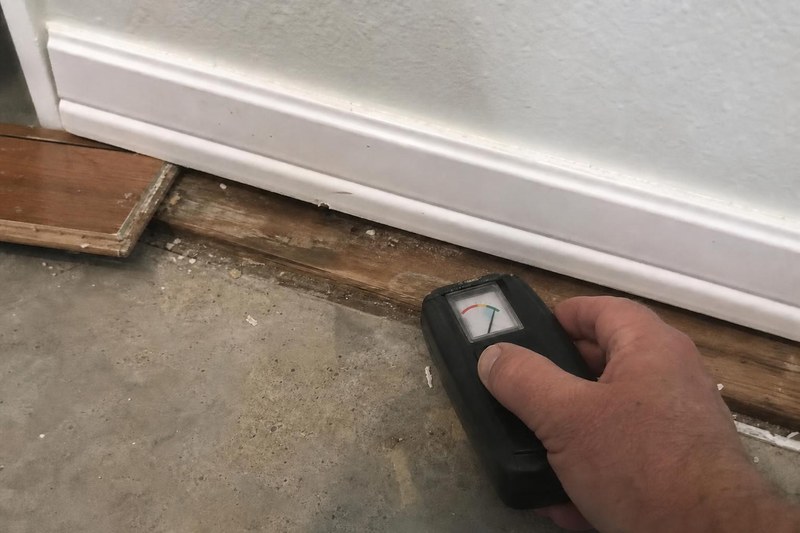
By the time a slab leak gets found and stopped, water has usually already been sitting under the flooring, up inside a wall cavity, or against a baseboard for longer than anyone realized. That is where our part starts. We pull up flooring where the water has traveled, extract what is trapped underneath, and set moisture meters into the subfloor, drywall, and framing so the drying equipment runs until the readings say the structure is actually dry, not until the surface feels that way underfoot.
Slab-on-grade water intrusion rarely stays where the pipe failed. It spreads sideways under baseboards toward the far side of a room, so a floor that looks fine two feet from the leak can still be holding water a moisture meter would catch instantly. Getting ahead of that spread is also what keeps a wet subfloor from turning into a mold problem behind the wall a few weeks later. Along the way, we keep a running record, moisture numbers alongside dated photos, so your insurance claim rests on something solid instead of your memory of a stressful week. A pipe that fails suddenly and floods a room is typically treated as sudden and accidental damage, which most policies cover for the cleanup side, even when the plumbing repair itself falls under a different part of the policy or none at all. Your adjuster makes that call for your specific claim, not us.
If the water is still actively spreading when you call, that is exactly what our emergency water removal crew handles first, and the same drying standard our McKinney water damage team holds for a burst pipe applies here too, whether the source was visible from the start or hidden under a slab for weeks.
Questions McKinney Homeowners Ask About Slab Leaks
Water From a Slab Leak Showing Up in Your McKinney Home? Call for the Cleanup Side.
Once the leak itself is found and stopped, our McKinney crew handles the extraction, drying, and mold prevention so the water damage does not spread any further.
📞 Call (972) 764-8722