
What a Texas Hard Freeze Does to a Two-Story McKinney Home
The freeze breaks, the roads clear, and two days later a McKinney ceiling starts to stain. Here is why the damage waits for the thaw in a two-story home, and what to watch for.
📞 Call (972) 764-8722 Now ★★★★★ 5.0 rating on GoogleThe freeze warning comes off the news Wednesday night, and by Friday afternoon the roads are clear and the sun is back out over McKinney like nothing happened. That two or three day gap, after a hard freeze has already passed but before the house shows any sign of it, is exactly when a lot of Texas hard freeze water damage actually starts showing itself. A pipe that cracked under the ice on day one does not necessarily leak on day one. It waits for the thaw, and in a two-story home that wait usually ends with water in a ceiling instead of on a slab.
Single-story slab homes get their own kind of freeze damage, and it is a different story from what plays out in a two-story house. Here is what actually happens between the cold snap and the moment water shows up somewhere you can see it.
Where the Cold Actually Reaches a Two-Story Home's Pipes
Most single-story McKinney homes keep their plumbing low, tucked under a slab where the ground itself holds a little heat through a freeze. A two-story house does not get that break for its upper-floor lines. Supply pipes feeding a second-floor bathroom or laundry room often run up through an exterior wall cavity or across the attic space above the ceiling, both spots where insulation is thin and outside air sits close to the pipe.
In newer sections of Trinity Falls and Painted Tree, built out over the last decade, and in Craig Ranch, which has been filling in for closer to two decades, on the 75071 and 75070 sides of McKinney, a second-floor laundry room commonly sits stacked over the garage, and that supply run crosses an unconditioned garage ceiling before it ever reaches conditioned living space. A garage is usually the coldest interior spot in the whole house during a hard freeze, colder than an insulated attic and colder still than any wall inside the living area, which is exactly why a burst pipe hard freeze event in McKinney tends to start there.
Nothing Leaks While the Ice Still Holds
A pipe does not need to fully thaw to crack. As water freezes inside a section of pipe, it expands and pushes pressure toward whichever end is closed off, and that pressure alone is often enough to split a fitting or a straight run of pipe before the ice ever lets go. What keeps the house dry in the meantime is the ice itself. A frozen plug sitting inside a cracked pipe acts like a cork, so the break can sit behind a wall or above a ceiling for two or three days with nothing to see and nothing to hear.
That is the part that catches homeowners off guard every year. The freeze can already be over, the pipe already split, and the house still shows no sign of it, because the thing holding the water back is the same cold snap that caused the crack in the first place.
The Thaw Is When the Real Damage Starts
Once temperatures climb back above freezing, usually within a day or two of the cold snap breaking across North Texas, that ice plug starts to give way, and it rarely melts evenly. The middle of the blockage often opens first, which sends water moving through a still-narrow channel at full house pressure right into whatever crack has been sitting there quietly. That is the moment a hard freeze turns into a water damage call instead of just a weather story, and it is why McKinney's phones tend to go quiet during the coldest hours of a freeze and then start ringing hard over the two or three days after.
The National Weather Service's Fort Worth and Dallas office tracks that exact warming window for North Texas, and it is worth watching, because the days right after a hard freeze breaks are usually when Collin County sees its heaviest run of burst-pipe calls, not the days the temperature actually bottomed out. The statewide freeze events the Texas Division of Emergency Management tracks show the same pattern everywhere the cold reaches: damage reports cluster after the ice breaks, not during it.
How a Second-Floor Break Reaches the Rooms Below
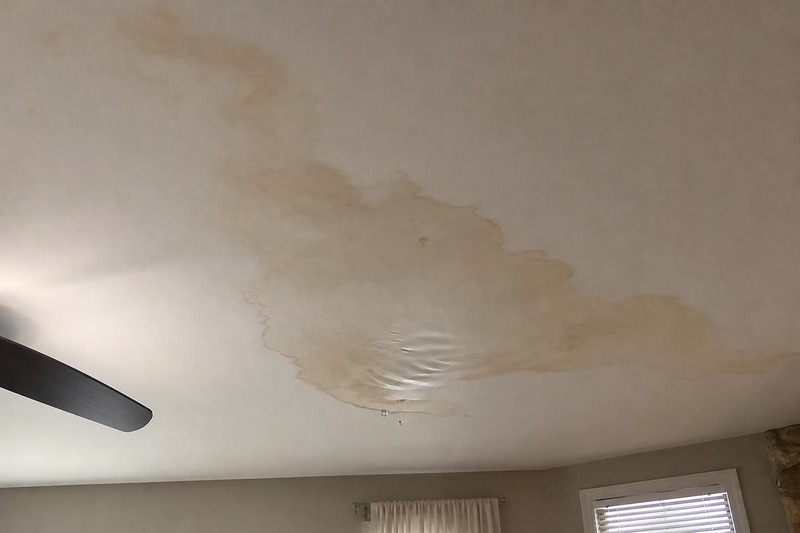
In a single-story slab home, a burst pipe spreads sideways under the flooring. A second-floor break behaves differently, and that difference is what makes it a bigger job in less time. Water leaving a cracked line above a ceiling does not pool where it started. It follows the ceiling joists downhill, soaking insulation and drywall along the way until it finds the lowest point in that stretch of ceiling, usually a recessed light, a vent, or a seam in the drywall.
That is where it lets go, often starting as a stain that spreads and darkens before it opens into an actual drip, then a steady flow, into whatever room sits directly underneath. A break over an upstairs bathroom or laundry room in a two-story McKinney home can put water into a first-floor living room, kitchen, or garage ceiling within hours of the thaw starting, and by the time it reaches the slab underneath, both floors are wet, not just the one where the pipe let go.
Once water has reached that point, the fix is not a mop and a fan. It is the same extraction and structural drying job our emergency water removal crew runs on a ground-floor flood, just working top to bottom instead of floor to wall: pulling water out of the upstairs cavity first, then drying the ceiling and any first-floor surfaces it reached before the moisture has time to spread further or turn into a mold problem behind either ceiling.
None of this requires a visible stain before you act. If a downstairs ceiling looks discolored, if there is a musty smell that was not there a week ago, or if a hard freeze just passed and you want the upstairs lines checked before more water finds its way down, call and someone at our McKinney water damage crew will walk through what to check first.
What Two-Story McKinney Homeowners Ask After a Hard Freeze
Notice a Stain or a Drip After a Hard Freeze? Call Before It Spreads.
Call and someone picks up right away to walk through what to check upstairs before more water reaches the rooms below.
📞 Call (972) 764-8722