
Water Damage Restoration in Historic Downtown McKinney, TX
A galvanized supply line finally rusted through under the kitchen sink, or a musty smell behind an original plaster wall that will not go away. Dispatch keeps the phone covered around the clock, and a crew gets headed to your address near the square.
📞 Call (972) 764-8722 Now ★★★★★ 5.0 rating on GoogleA Craftsman Near the Square Loses a Supply Line
Someone opens the cabinet under the kitchen sink in a hundred year old house a few blocks off the square and finds the floor of the cabinet soaked through. The supply line behind it is galvanized pipe that has been feeding that sink since long before anyone currently living there was born, and it finally rusted through overnight. By morning the hardwood near the baseboard has started to cup, and the smell in the kitchen is not one anyone wants to wait on.
That is a different call than one from a five year old house going up on the edge of town. The fittings failing behind these walls in Historic Downtown McKinney have often been in place since Eisenhower was president, not since a builder walked off the job three years back, and that changes what a crew is actually walking into. Whoever answers still covers the same ground, day or night: what to shut off, what to leave alone, and how fast a crew can get loaded up for your address.
Finding the source is rarely a five second job in a house this age. The shutoff itself is sometimes original, corroded into place, or hidden behind a cabinet someone built in decades after the plumbing went in. The crew works through it methodically instead of guessing, because in a house where the fittings are original, forcing the wrong valve can turn a kitchen leak into a bigger job than it already is.
Plaster, Pier and Beam, and Roots in the Sewer Line
Most of the newer subdivisions ringing McKinney, Stonebridge Ranch and Craig Ranch among them, sit on a concrete slab, so a leak travels beneath the surface and shows up first as damp grout lines before it ever reaches a wall. A lot of the older homes packed into the historic core work differently. Many still sit on a pier and beam foundation with a crawlspace underneath, which means water can drop straight down through the subfloor and soak into joists from below at the same time it is spreading across the surface above, a pattern a slab home never has to deal with.
The walls complicate it further. Victorian and Craftsman homes built through this district in the late 1800s and early 1900s were finished with lath and plaster, not the drywall that went into every house built after. Plaster does not sag or stain the way drywall does when it takes on water, so a slow leak inside a wall cavity can sit for weeks with almost nothing to see from the room side, until a section finally softens or a musty smell finally gives it away.
Then there are the trees. The oaks and pecans that shade these streets have had a century to grow root systems that find every seam in an old clay or cast iron sewer line running under the yard, and root intrusion cracks pipe in ways a newer PVC line out in a subdivision almost never has to contend with. A slow drain that keeps backing up is not always a clog you can clear yourself, and when it is a sewage backup instead of a clean supply line failure, that changes how the cleanup gets handled from the first step.
Extraction and Drying That Respects What's Original
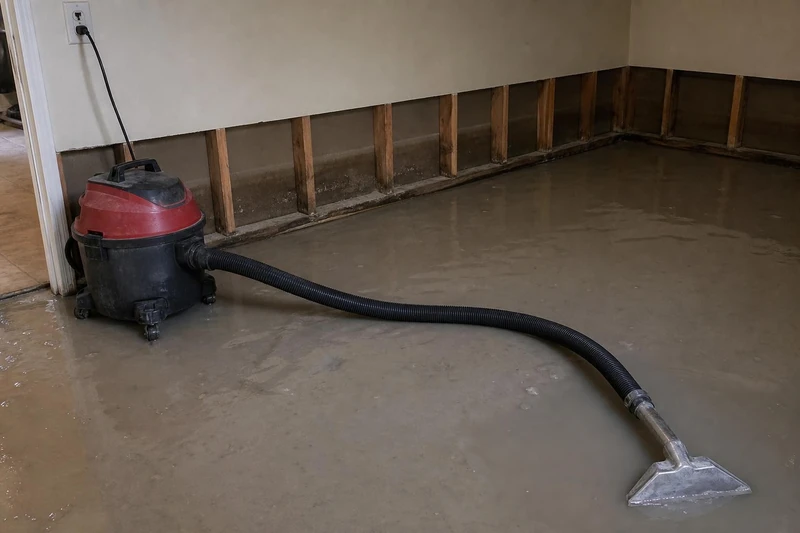
The extraction itself starts the same way it would anywhere: a truck mounted unit pulls the bulk of standing water off the floor, and portable extractors finish what soaked into carpet, pad, or rugs. Original hardwood reacts to standing water faster than the engineered flooring that goes into most newer builds, so getting water off it quickly matters more here than it does in a subdivision kitchen with vinyl plank underfoot.
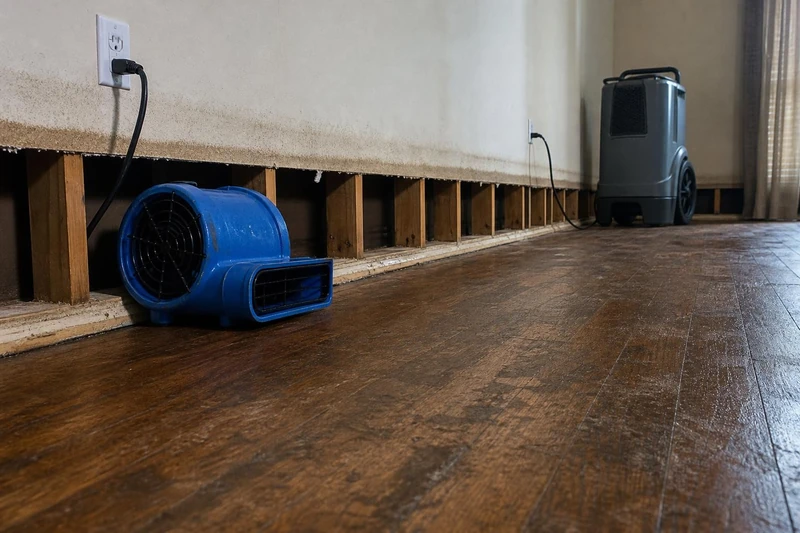
Drywall gets cut open once a moisture meter confirms water is trapped behind it, and the same standard applies to plaster, but the approach is more careful. Plaster is heavier, it is original to the house, and it is not something a homeowner in a historic district wants opened up by default the way a contractor might treat drywall out of habit. The crew reads the moisture levels, dries what can be dried in place with air movers and dehumidifiers, and only opens a wall when the readings actually call for it rather than assuming the worst from the start.
That same crew handles whatever the call turns into. Smoke or soot damage in one of these older downtown McKinney homes runs through the same fire damage restoration team, and once plaster walls have held moisture long enough for a musty smell to show up behind them, that is a job for mold removal. Testing and inspecting for mold is not a service this crew performs. Bring us the protocol your own independent, TDLR licensed assessor writes, and this crew carries out the removal work it calls for.
The Streets We Cover Around the Square
Historic Downtown McKinney sits inside the 75069 ZIP, and it is a small enough area that most of it is walkable from the courthouse square, past the shops and restaurants lining the streets around it, out to the residential blocks of Victorian and Craftsman homes that give the district its character. We cover every one of those streets, whether the house dates to 1905 or is one of the newer infill homes built to match the original footprint next door.
Tucker Hill, the neotraditional community about six miles west on US-380, borrows this district's Victorian and Craftsman architecture even though it sits in its own ZIP, 75071, and it gets covered by the same crew. Head further out and the housing shifts again, into the slab foundations and newer supply lines of subdivisions like Stonebridge Ranch and Craig Ranch, and the crew that answers a call there runs the exact same extraction and drying standard, just against a different set of problems.
Winter is the season that tests old plumbing hardest here. Exposed or uninsulated supply runs in a century old house have less protection than anything built to current code, and the Texas Division of Emergency Management puts out the same hard freeze preparedness guidance every winter for exactly this reason. If a cold snap catches an old line the way it has before, that is the moment to call rather than wait and see. For everything else, this crew backs up water damage restoration across McKinney, historic core included.
Questions From Homeowners Near the Square
Where to Find Us in McKinney TX
No phone tree when you call, and we give you a straight arrival window before we roll.
Water Showing Up in Your Historic Downtown Home? Call and We Get Moving.
Whoever's on shift sorts out extraction and drying built around what is original to your house, not just what is fastest, day or night.
📞 Call (972) 764-8722