
Water Damage Restoration in Little Elm, TX
A supply line let go in Union Park, or water is pushing in near Sunset Pointe, and it isn't waiting for morning. Whoever's on shift gets a crew heading toward your Little Elm address right away, day or night.
📞 Call (972) 764-8722 Now ★★★★★ 5.0 rating on GoogleLittle Elm Sits on the Lake, in a Different County Than McKinney
Little Elm runs along the north shore of Lewisville Lake, and it sits in Denton County, not the Collin County line that covers McKinney and most of the towns closer to US-75. That line matters less for who answers the phone and more for how water behaves once it's inside a house here: higher ground moisture near the shoreline, a stormwater program run by the town instead of the county, and a housing stock split between older streets near the original townsite and the newer phases going up around Union Park.
A supply line let go behind a wall in Union Park on a weekday afternoon not long ago and ran into the subfloor for the better part of a day before anyone felt the give underfoot. Whoever answers the phone here has heard that scenario before, walks a homeowner through what to shut off, and already has a crew on the way by the time the call wraps up. Our water restoration crew across the McKinney metro runs that same process for a lakefront address in Little Elm as it does clear across town near Historic Downtown McKinney.
The Paperwork Starts Before the Water Stops Moving
Most homeowners assume the insurance side of a water claim starts once the adjuster shows up. In practice, the record that decides how smoothly that claim moves gets built the moment a crew walks through your Little Elm front door. Photos of the damage as it actually looked, moisture readings from the first pass through the house, and notes on exactly where the water traveled all go into that record before extraction even finishes.
That matters more in a newer subdivision like Union Park than it might elsewhere. Builds finished in the last several years still carry manufacturer warranties on plumbing and appliances, and a documented failure with a timestamp can be the difference between a covered claim and a drawn out argument about when the leak actually started. Older sections of Little Elm closer to the original townsite don't have that warranty cushion, so the moisture logs and dated photos carry even more of the weight once the claim gets filed.
None of this is guesswork dressed up as paperwork. A dated log of what the meters read on day one versus day three is what tells an adjuster the structure actually dried to a real reading.
Getting the Water Out, Then Proving the Structure Is Dry
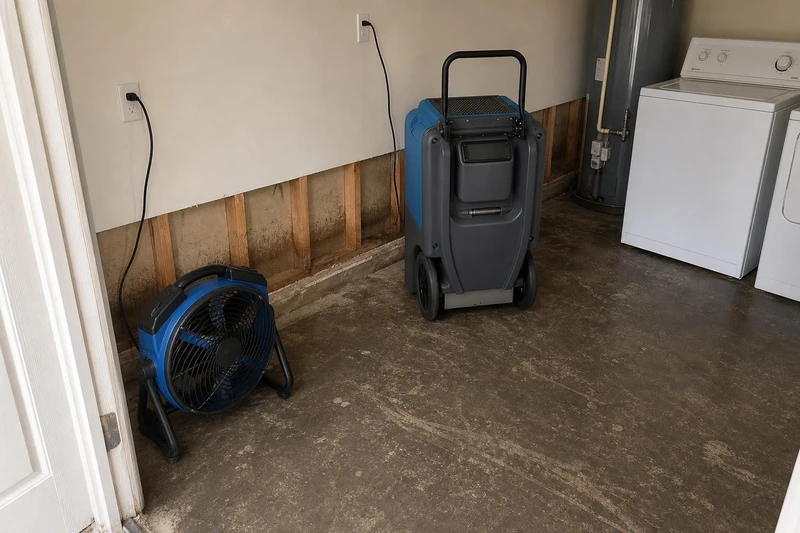
Standing water comes off the floor first, pulled with extraction equipment built to move gallons off tile and hardwood faster than anything sitting in a homeowner's garage. Carpet and pad hold onto water differently, so a second pass with portable extractors follows before anyone calls the visible water gone. That two-step order is what separates real water mitigation from a shop vac and a hope that the rest evaporates on its own.
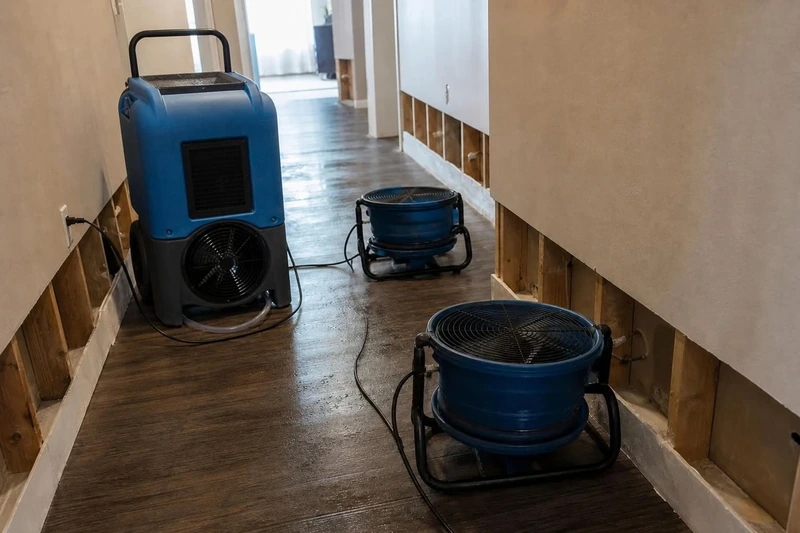
Once the surface is clear, the harder part starts. Air movers and commercial dehumidifiers get positioned according to where a moisture meter says the water actually traveled through subfloor, drywall, and framing. A room here doesn't get marked finished because it feels dry underfoot; it's marked finished when the meter backs that up, not before, which is the whole point of water damage repair done as a full job instead of a half one.
That standard holds whether the water traveled two feet or twenty. Lots this close to the lake often carry a higher water table for parts of the year, so a slab that would read dry somewhere else in the metro can still be holding moisture well after the visible cleanup looks finished, which is exactly why the drying plan follows the readings and not the calendar.
Why Homes Near the Lake Take On Water Differently
Little Elm sits along Lewisville Lake, and that changes the water story compared to towns further from the shoreline. Lake-adjacent lots in Sunset Pointe carry a higher water table for parts of the year, which means a slab that would drain fine somewhere else in the McKinney metro can hold moisture longer after a hard rain.
The newest builds around here fail on a different clock. Union Park and the subdivisions built out over the last decade tend to run two-story floor plans with a laundry room or upstairs bathroom stacked directly over finished living space, so a failed supply line on the second floor becomes a ceiling and flooring job downstairs within the hour. That is a different failure point than the older, one-story sections nearer the lake, where slab age and original plumbing runs are more often the culprit.
Runoff plays a role too. The Town of Little Elm's stormwater utility program tracks drainage across the town's lake-adjacent grading, and a fast summer storm can push water toward a garage or low entry point faster than the ground can absorb it in the newer developments where impervious surface has gone up quickly. That is the same drying discipline that goes into a flood cleanup after a bigger storm, just triggered by a smaller, more localized push of water. Combine all of it with the humidity North Texas carries most of the year and water that sits in a wall cavity here does not dry out on its own, it waits for someone to pull it out.
Union Park, Sunset Pointe, and the Streets Between Them
Little Elm runs largely under ZIP 75068, and the crew that answers your call already knows the neighborhood layout before the truck leaves the lot. Sunset Pointe's lake-facing lots sit inside that ZIP, and Union Park's streets get the same coverage across Little Elm regardless of exactly where the ZIP line falls. The two neighborhoods fail differently enough that knowing which one you're calling from actually changes what the crew expects to find on arrival.
Coverage does not stop at the town line either. The same crew answering calls in Little Elm also works the suburbs ringing McKinney, from Frisco to The Colony just south along the lake. If smoke and soot are the story instead of standing water, that same crew handles the fire and smoke damage cleanup Little Elm homeowners call for under the same documentation-first approach. And if a leak sat long enough to leave a musty smell behind a wall, bring us the written protocol your own independent, TDLR-licensed assessor produces, and our mold remediation team in Little Elm carries out exactly what that protocol calls for.
What Little Elm Homeowners Ask Before They Call
Where to Find Us in McKinney TX
No phone tree when you call, and we give you a straight arrival window before we roll.
Water Moving Through Your Little Elm Home? Call and We Get to Work.
Whoever answers skips the hold music and gets extraction and drying started before more of the house is affected.
📞 Call (972) 764-8722