
Water Heater Failure in a Two-Story McKinney Home
A water heater tucked in a second-floor closet fails quietly, and the first sign is often a stain spreading across the ceiling of the room below it.
📞 Call (972) 764-8722 Now ★★★★★ 5.0 rating on GoogleYou hear a drip in the upstairs hall closet and figure it can wait until the weekend, then a day later there is a brown ring spreading across the kitchen ceiling below it. That gap between "small leak upstairs" and "water coming through the drywall downstairs" is the whole problem with where a lot of McKinney builders put the tank. In the newer two-story subdivisions going up around the city, the water heater rarely sits in the garage anymore. It sits in a closet off the second-floor hallway or tucked into an attic space, freeing up a few square feet on the ground floor plan, and nobody thinks about it again until the day it fails.
A water heater leak upstairs does not stay contained the way a garage failure does. Gravity takes over the second the tank or a fitting lets go, and a failed water heater flooding a second-floor closet becomes a first-floor ceiling problem before you ever hear the tank itself fail. That is a different animal than the standing-water calls our emergency water removal crew runs on a kitchen or bathroom floor, and it is worth understanding before it happens in your own hallway closet.
Why an Upstairs Closet Changes the Math
Putting the tank on the second floor makes sense on paper. It shortens the hot-water run to upstairs bathrooms, it keeps the garage floor open, and in a lot of Trinity Falls and Painted Tree floor plans built over the last decade it sits inside a small utility closet off the hallway, out of sight and mostly out of mind. The tradeoff shows up the day the tank finally corrodes through or a fitting cracks. A garage failure spreads across a slab and toward a floor drain. An upstairs failure has nowhere to go but down, through subfloor, insulation, and the drywall ceiling of whatever room sits directly underneath.
Most residential tanks are built for somewhere around eight to twelve years of service before corrosion catches up with them, and a lot of McKinney's newer construction, from Craig Ranch in 75070 to the two-story sections of Trinity Falls and Auburn Hills in 75071, is now old enough that original units are aging into that window. Across Collin County and the rest of North Texas, that math does not change with the seasons the way a frozen pipe does. A water heater fails whenever corrosion or sediment finally wins, which means the risk sits there year round, not just during a January cold snap.
Signs the Tank Is About to Go
A tank rarely fails without leaving a trail first, but the trail is easy to miss when the unit itself is behind a closet door you open twice a year. Watch for these before the failure turns into a downstairs repair job:
- Rust colored water stains around the base of the tank or its fittings
- Popping or rumbling sounds from the closet as sediment builds up on the tank floor
- A soft spot, sag, or brown ring on the ceiling of the room directly below the closet
- A warm or damp patch on that same ceiling, even without visible staining yet
- A musty smell in the hallway or room below that was not there last week
- Damp baseboards or carpet in the downstairs room before anything looks wrong upstairs
None of those signs by itself means the tank is about to go. What changes the odds is how many show up together and how old the original unit is: a decade-plus water heater throwing off two or three of these at once is worth an inspection before the closet turns into a ceiling and flooring job.
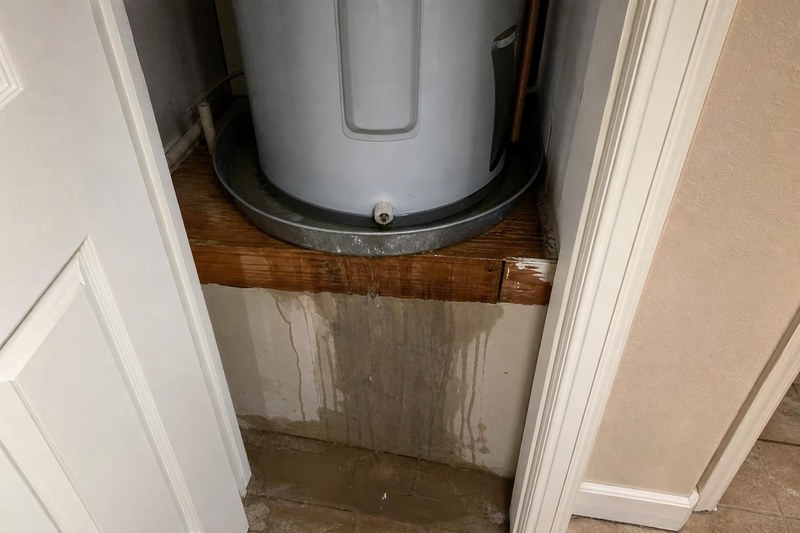
What the Pan and Drain Line Are Supposed to Catch, and What They Miss
Most upstairs installations include a shallow metal or plastic pan under the tank with a drain line running to a floor drain or out to an exterior termination point, away from the framing below. That setup does its job for what it was built for: condensation, a slow weep from a fitting, a small overflow. It is not sized to hold or route the volume a full tank rupture produces, especially with the supply line still feeding the leak until somebody shuts the valve. A cracked pan, a drain line that was never properly connected, or one that got kinked or disconnected during some other repair years ago turns what should have been a contained drip into water running straight across the closet floor and into the subfloor beneath it.
That is close to the logic behind the Texas Department of Insurance's own guidance on when a water damage claim gets covered: insurers draw a hard line between a sudden failure and one that sat quietly unmaintained, and a pan or drain line nobody has checked since the house was built does nothing to move a claim into the sudden-and-accidental column.
The First Few Minutes, and What Happens After You Call
If you catch a leak before it turns into a flood, shut off the water supply valve at the heater itself if you can reach it safely, or at the home's main shutoff if you cannot. Cut power at the breaker for an electric unit, or the gas valve for a gas unit, if that is safe to reach. Do not flip on a ceiling light or run a fan in the room below if the fixture looks wet or the ceiling is sagging, since a soaked electrical box is not something to test by hand. Move anything valuable out from under the affected ceiling, then call.
From there the job runs on both floors at once. The same crew we send across McKinney that handles a kitchen floor or a flooded first story runs extraction and drying in the closet and any exposed attic decking upstairs, while working the ceiling, wall cavity, and flooring of the room below with moisture meters checking subfloor, drywall, and framing rather than guessing from what looks dry. Saturated insulation in that ceiling cavity almost always has to come out rather than dry in place, since wet insulation loses its ability to insulate and holds moisture against the drywall long after the surface looks fine. North Texas humidity, the kind the National Weather Service's Fort Worth office tracks for the whole region, only slows that process down further if it is left alone. Photos and moisture readings get logged at every stage so the file backing your insurance claim reflects what actually happened, not a guess pieced together after the fact.
Questions About an Upstairs Water Heater Failure
Ceiling Staining Below an Upstairs Water Heater? Call Now.
Call the moment a stain shows up below the closet, and the same crew that handles a flooded kitchen floor gets moving upstairs too, day or night.
📞 Call (972) 764-8722